
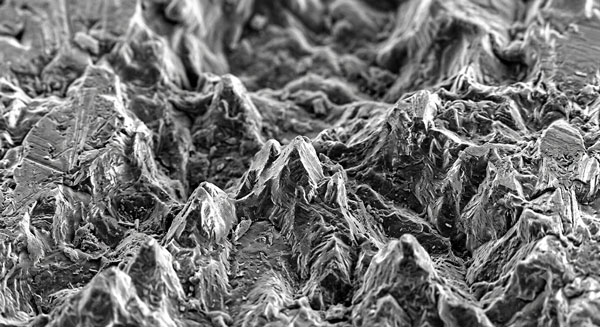
It might come as a surprise to you, but even the smoothest looking aluminum coil has a texture, or topography, to it. If you looked at aluminum under a microscope, you would see a rather complex landscape of peaks and valleys. Roughness is more than just a measurement; it’s an important performance indicator. In this post, we’ll look closer at surface roughness, how it’s measured, and why you should be paying attention.
Why Surface Roughness Matters for Aluminum Coils
Surface roughness affects several key performance factors as follows:
Coating Adhesion – in order for coatings such as polyesters, epoxies or anodized layers to properly “stick”, certain surface conditions must exist. The requirements can change based on the coating.
Forming and Friction – during aluminum fabrication processes, such as deep drawing or stamping, a rougher surface allows lubricants to adhere to it. Otherwise, if the material was too smooth, it could possibly gall or tear when being processed.
Aesthetics – for surface critical applications, aluminum’s surface roughness is one factor that will determine the appearance of the final product and how light reflects off the surface.
Ways to Measure Surface Roughness
There are several methods to measure the surface roughness of aluminum coil.
Stylus Profilometry – This is the most common method which is globally recognized by ISO 4287 and ASTM B46.1 standards. Here, a diamond-tip needle is drawn across the surface, and records vertical displacements to map the profile. There are multiple scales on which you can measure the surface roughness, including Ra, Rz, and RMS. Ra is the arithmetic mean roughness and is the most common way to measure surface roughness for aluminum strip. Ra can be measured in microinches (µin) or micrometers (µm). Lower Ra values indicate smoother surfaces, while higher values indicate rougher surfaces. Although stylus profilometry is regarded as being highly accurate, the stylus can sometimes mark soft aluminum alloys. The measurement technique is also sensitive to any blemishes on the surface of the aluminum; therefore, you must have a clean unhandled sample of aluminum to measure the surface roughness. So this must be carefully taken into consideration when using this approach.
Optical (Non-Contact) Profilometry is used for more sensitive surfaces or complex 3D mapping. With this approach, laser scanning or white light interferometry utilize light reflection to map the aluminum’s topography. This eliminates the risk of surface damage. It provides a 3D view of the texture, using areal parameters Sa, the 3D equivalent of Ra and Sz, which is the 3D equivalent of Rz. Together, these readings will provide a much more accurate representation of the surface when compared to the stylus method. However, there are some drawbacks since aluminum’s high reflectivity can interfere with optical sensors. In certain cases, specialized equipment or surface prep may be required to help deal with this.
In-line Measurement – this process is used in high volume mills to monitor aluminum’s surface as it moves through the line. It relies on either laser triangulation or scattered light sensors to do its job. With laser triangulation, a laser beam hits the moving surface, and the scatter of its light is captured by a high-speed inspection camera. How it bounces off peaks and valleys allows the roughness profile to be calculated digitally in real time. Scattered light sensors work a little differently. The sensors measure the light’s intensity at different angles. Rough surfaces will scatter the light widely, while smooth ones will reflect it like a mirror.
In-line systems are generally less precise than the lab grade approaches mentioned earlier. But they serve a crucial role in determining if the aluminum’s surface is within the required spec. Plants will use this in-line data for trend control, rather than final certification. It helps operators understand milling process deviations. For instance, changes in the aluminum’s smoothness can indicate that it’s time to change out the steel rolls that press it.
Conclusion
Surface roughness is a critical and sometimes overlooked characteristic of aluminum coils that directly impacts their performance. The industry has developed several methods to measure it, based on the requirements, and processing conditions. When sourcing aluminum coils, it’s essential to understand how surface roughness will affect your product and application. When you get it right, you will maximize coating performance, reduce processing defects, and achieve the desired visual results when required.
