
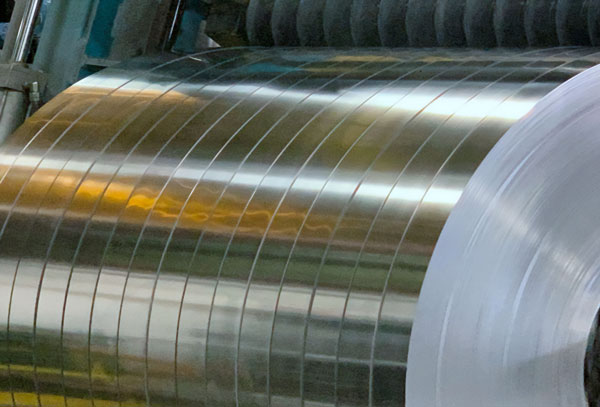
Aluminum strip is a precisely processed flat-rolled form of aluminum that is characterized by narrow width. The phrase is often used interchangeably with “aluminum coil”, but in reality, they are related but different. Essentially, strip is a by-product of a master coil, which is slit to certain dimensions. Aluminum strip is typically used in high-speed manufacturing processes. Let’s take a closer look at strip, how it’s made and how it’s used.
Characteristics of Aluminum Strip
A key defining characteristic of strip is that it is held to incredibly tight tolerances. This is a must for continuous-motion machining, such as stamping or winding, to be successful. The slightest deviation, even just a few thousandths of an inch, can jam automated feeders. This leads to downtime, and all of the associated headaches that come with it. Holding a tight tolerance across the entire length of the strip offers the level of consistency needed for machines to run smoothly.
Besides being narrower than coil, aluminum strip also tends to be thinner. They are also more uniform in thickness. If you’ve read this far, you already know why – it’s to keep those automated machines happy.
How is Aluminum Strip Made?
The process of manufacturing aluminum strip is as follows:
-
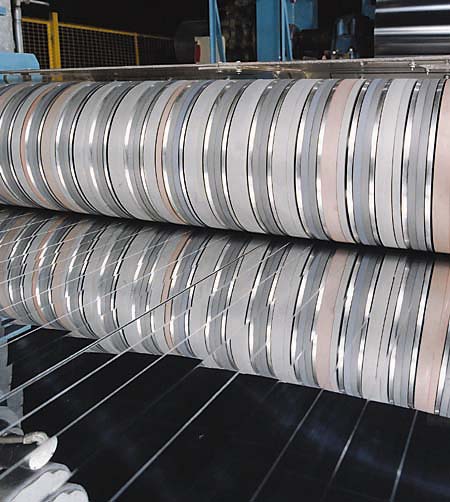
Aluminum being slit to customer specifications
Melting and Casting – the process begins when primary aluminum ingots are melted down. Alloying elements such as magnesium or manganese are also added to alter the materials properties as required.
- Rolling – The material is then heated into a pliable temperature and passes through a series of hot rollers that reduce the ingots thickness down to a fraction of an inch. Once cooled, it then undergoes cold rolling at room temperature. Here, the aluminum is pulled through high-pressure rollers to achieve final gauge, surface finish and increased strength.
- Annealing – often, the coils are then placed into annealing furnaces to soften the metal and to achieve a specific temper.
- Precision Slitting – this is the magic step where a coil becomes aluminum strip. The master coil is loaded onto a slitting line, and is precisely cut by rotary knives to the desired width.
- Recoiling/Packaging – now that the strip meets width and thickness requirements, it can be wound onto individual cores. As a final step, they are typically weighed and tested prior to leaving the facility.
Aluminum Strip Applications
Aluminum strip is used for many demanding and specialty applications that require precision above all. A few common ones include:
-
- HVAC, Heat Exchangers, and Automotive – while these are separate uses, they all rely on aluminum strip for fin stock. Precision aluminum fins are found in radiators, AC units, heat exchangers and similar applications. All require high thermal conductivity and thin gauges.
- Electrical Power – used in transformers, conductors, and cable shielding due to its conductivity and corrosion resistance
- Telecommunications/Data Cabling – strip is often used as shielding tape for fiber optic and coaxial cables.
- Consumer Electronics – strip is found in countless retail goods such as dryers, refrigerators and laptops. It is often used for structural brackets, heat sinks, and decorative trim.
- Flexible Packaging – specialized strip is often required for deep-drawn components and closures in various types of packaging.
- Building and Architectural – strip can be used for rain gutters and downspouts to architectural trim and other features.
Strip Alloys
Performance demands vary across aluminum strip’s many applications. Let’s look at some of the typical uses for aluminum alloys, broken down by series:
- 1xxx Series – is typically found in electrical/transformer applications, as it has the highest conductivity.
- 3xxx Series – has great corrosion resistance, making it perfect for HVAC, fin stock, and other uses subject to corrosive environments.
- 5xxx Series – has the highest strength-to-weight ratio. This makes it ideal for architectural and marine-grade tubing, or similar uses.
Conclusion
Aluminum strip is more than just narrow coil. It’s a form of aluminum that is needed to support the demands of modern automated manufacturing. Precision and consistency are absolutely critical to be successful. When sourcing strip, be sure to work with a mill that is passionate about quality, and has the certifications and documentation to prove it.